

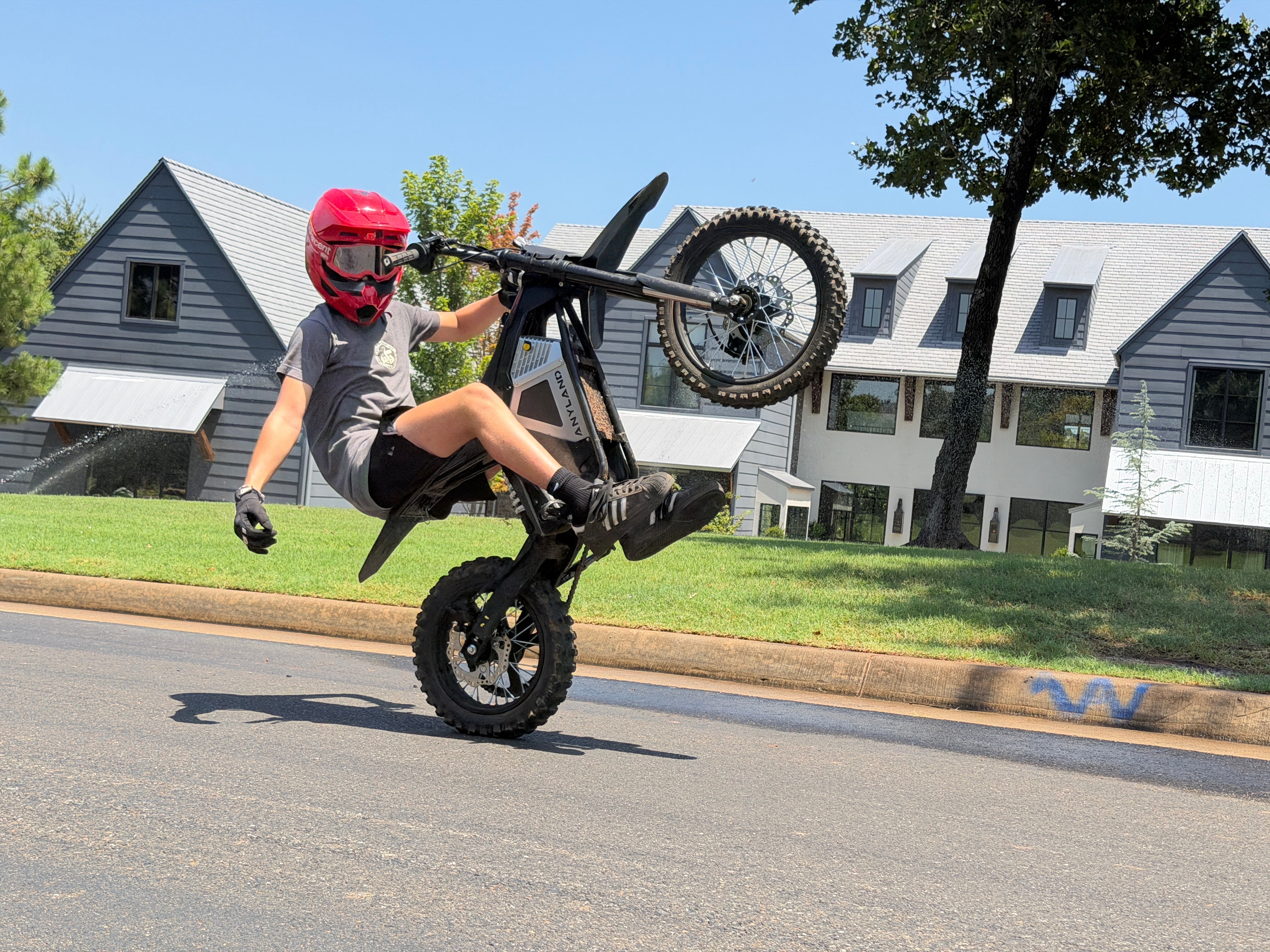
How to Wheelie an Electric Dirt Bike | WELIXON™ Wheelie Assist
Wheelies look simple until the front wheel leaves the ground; the real challenge is managing that power while staying loose, finding the balance point, and covering the rear brake.
This guide breaks the skill into practical steps—throttle control, body position, and rear-brake technique—then explains how the Anyland Rev Pro's WELIXON™ Wheelie-Assist Control System helps beginners practice with more control and less fear of looping out.

Three Things to Nail Before You Ever Try a Wheelie
1. Get a Feel for Your Throttle
Electric dirt bikes hit differently than gas bikes—power shows up instantly, with no revs to build and no clutch to feed out. That's part of what makes them so fun. It's also why sloppy throttle input punishes you faster.
On the Anyland Rev Pro, the throttle is tuned for smooth, linear power delivery, so small wrist movements translate into predictable changes in output instead of a sudden surge. That makes it easier to build the precise throttle control a clean wheelie requires.
"More throttle equals a bigger wheelie" is the classic beginner mistake, and it's backwards. A clean wheelie comes from a small, smooth input - not a bigger one. Before you try to lift the front wheel, spend time just learning:
-
how fast your bike responds to throttle
-
how much power you actually have on tap
-
how the bike behaves as your weight shifts back
2. Loosen Up Your Body Position
Your body does more work in a wheelie than your right hand does. Most beginners fight the bike because they lock up—straight arms, tense shoulders, and death grip on the bars.
Instead:
-
keep your arms bent and loose, not straight
-
eyes up, looking where you're going
-
let the bike move underneath you instead of holding it rigid
-
use your body position for balance, not brute force
A good wheelie isn't about pulling harder on the bars. It's about staying loose and making small, controlled corrections.
3. Control Wheelie Mode with the Throttle
Traditional wheelie technique often teaches riders to use the rear brake as a recovery tool. The Anyland Rev Pro works differently when Wheelie Mode is active: the lift is controlled through the throttle rather than by using the rear brake to regulate the angle.
Use small, smooth throttle inputs to control how quickly the front wheel rises and how the wheelie feels. Ease off the throttle smoothly when you want to slow the lift or bring the front wheel down. Using the rear brake to control the wheelie is not recommended while Wheelie Mode is active.

What WELIXON™ Wheelie Assist Actually Does (and Doesn't Do)
The WELIXON™ Wheelie-Assist Control System is built to help manage front-to-back balance while you're learning—providing an added layer of support that reduces the risk of looping out as you develop a feel for the balance point.
What it helps with:
-
Gives you a clearer feel for the balance point
-
Takes the edge off the fear of looping out
-
Makes early practice a lot less intimidating
What it won't do:
-
Ride the bike for you
-
Handle left-to-right balance
-
Replace actual practice time
You're still the one running the throttle, managing your body position, and making the call on where to go. Assist just makes the learning curve less punishing while you rack up the reps.
Why the Rev Pro Changes How You Learn to Wheelie
Most riders learn wheelies through trial and error, often while trying to find a balance point their muscle memory does not recognize yet. The Rev Pro makes that early stage more controlled without removing the skills you still need to build.
Here's how the WELIXON™ Wheelie-Assist Control System works:
-
Choose your angle. Select one of three preset limits—25°, 35°, or 45°—based on your comfort level.
-
Monitor pitch in real time. The bike's IMU continually tracks the front-to-back angle as the front wheel rises.
-
Adjust motor output. As the bike approaches the selected angle, the controller modulates power to help hold the front wheel near that limit and reduce the chance of looping out.
The system does not ride the bike for you. It manages part of the throttle finesse that causes many beginners to loop out, while leaving side-to-side balance, steering, body position, and rear-brake control to the rider.
The WELIXON™ system was co-designed with Moxin and tuned specifically for the Rev Pro's motor, battery output, throttle response, frame balance, and riding setup. That factory integration helps the assistant deliver predictable power without turning the bike into autopilot.

What Riders Actually Think of Wheelie Assist
The obvious question: Is this actually useful, or is it a gimmick bolted onto a spec sheet?
Electrek put it to the test directly. Publisher Seth Weintraub had his teenage son and a friend try the Rev Pro's three preset wheelie angles—25°, 35°, and 45°—to see how the assist actually felt in practice. Both kids already wheelied on BMX and mountain bikes but had been nervous about trying it on an e-motorcycle.
According to the review, the 25° setting didn't feel entirely natural at first. But after about ten minutes of practice, moving up to 35° felt noticeably more natural, and from there they worked their way up to the full 45° wheelie.
The review also confirmed something worth being upfront about: the system keeps you from looping out, but it doesn't handle side-to-side balance or steering—that part is still on the rider to figure out. Electrek's take was that this makes it closer to a progression tool than a shortcut: start locked in at a low angle, build the muscle memory, then dial the assist down as your own skills catch up.
The bigger-picture conclusion wasn't that Assist makes wheelies trivial. It was that cutting out the fear of falling removes the main reason most beginners quit before they get good—which lines up with what we've heard from other riders who've spent time on assist-equipped bikes.
*Source: Electrek, "Anyland Rev Pro e-motos have this one weird trick...auto wheelies!" , July 2026.
Is Wheelie Assist Cheating?
Not really. Wheelie Assist handles part of the throttle finesse that causes beginners to loop out, but it does not control steering, side-to-side balance, body position, or rear-brake technique. Think of it as a progression tool: start with a lower preset angle, build the right feel and muscle memory, then reduce or switch off the assist as your control improves.
Can Beginners Learn to Wheelie on an Electric Bike?
Yes. Instant torque, no clutch, and no gear changes make an electric dirt bike a predictable platform for repeated practice. WELIXON™ Wheelie Assist adds a controlled starting point, but the rider still needs a safe practice area, proper protective gear, and consistent work on throttle, balance, and rear-brake control.
Who's the Rev Pro Built For?
-
First-time wheelie riders who want a more controlled way to learn.
-
Riders rebuild confidence after inconsistent or intimidating attempts.
-
Anyone who wants adjustable assistance now and the option to practice fully manual wheelies later.
Share:
Auto-Wheelie Assist: Essential & Operating Guidelines